
├─ Hero/Introduction
│ └─ "Knowledge, insights, and support for conflict resolution"
│
├─ Blog & Articles
│ ├─ Mediation insights
│ ├─ Conflict resolution tips
│ ├─ Legal updates
│ ├─ Case studies (anonymized)
│ └─ Industry commentary
│
├─ Full FAQ Section
│ ├─ About mediation
│ ├─ About my services
│ ├─ Process & logistics
│ ├─ Costs & fees
│ └─ After mediation
│
└─ Mediation Hour (Twitch Streaming)
├─ What it is
├─ Schedule/when to tune in
├─ Past episode highlights
└─ Embedded Twitch player / link
Plan
<--
knowledge & insights - reflect a typical mediation flow - timeline - flexibility
need another comprehensive FAQ section entitled:
Mediation FAQs - Everything You Need to Know
do you want these? or move them elsewhere
🤝 The Business Partnership Deadlock
The Conflict: Two co-directors of a London-based consultancy reached a stalemate over the future direction of the firm, halting all operations.
The Resolution: Through a day of facilitated negotiation, we identified a "buy-out" structure that allowed one partner to exit fairly while the other kept the business running.
Outcome: Litigation avoided; the business remained operational and solvent.
🏢 The Workplace Grievance
The Conflict: A long-standing dispute between a senior manager and a team lead led to a formal grievance and high levels of staff stress.
The Resolution: A facilitated conversation allowed both parties to voice unheard concerns and agree on a new communication "charter."
Outcome: The grievance was withdrawn, and the team’s productivity returned within a month.
Knowledge, Insights, and Support for Conflict Resolution
Mediation works best when people understand the process and feel prepared. Here you'll find practical guidance, real-world insights, and resources to help you navigate disputes with confidence, whether you are considering mediation, currently in process, or simply curious about how conflict resolution works.
This space is designed to be genuinely useful. Some content will answer your immediate questions, while other pieces offer deeper exploration of the principles and practices that make mediation effective.
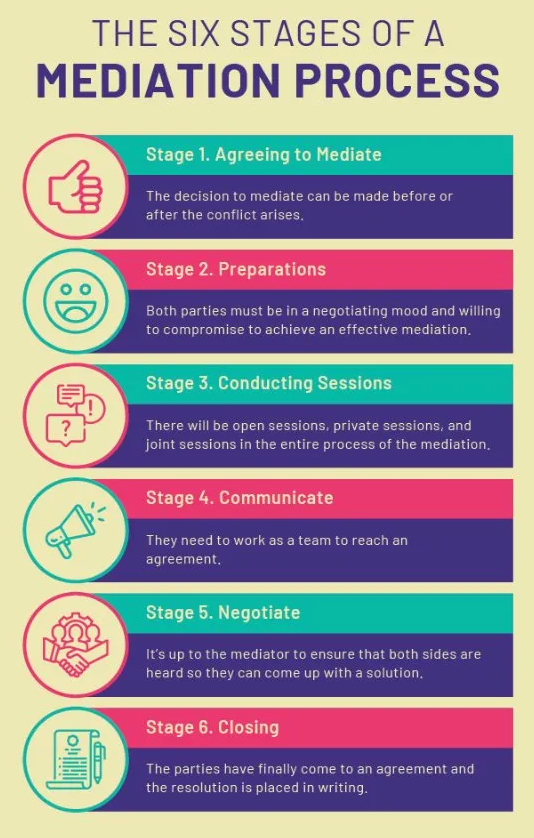
Mediation process
I wish I had design skills

Stage 1. Agreeing to Mediate
The decision to mediate can be made before or after the conflict arises.

Stage 2. Preparations
Both parties must have the authority and willingness to negotiate and compromise to acheive effective mediation.

Stage 3. Conducting Sessions
Mediation is a flexible process. There can be open sessions, private sessions, and joint sessions in the mediation process taking into account, safeguarding requitements and participant preferences.

Stage 4. Communicate
Participants need to work collaboratively to reach an agreement.

Stage 5. Negotiate
It's up to the mediator to ensure that both sides are heard, and there is ample opportunity to work towards a solution.

Stage 6. Closing
The parties have finally come to an agreement and the resolution is placed in writing. Once the document is signed it becomes binding on all parties involved.
Stage 7. Follow-up
Post-mediation support can involve checking in with parties and ensure there is effective implementation to ensure a lasting resolution.
Icons to generate:
1. Thumbs up - identical as above - with colours from left
2. identical (smiley face) with colours from left
3. Identical as above (speech/ communication) - in colours from left
4. Communicate - Megaphone - in colours from left
5. Negotiate - identical (but take gear out)
6. closing - identical but in colours
7. follow-up can be a hug or somehow show care
7. d
New content added regularly, from quick tips to in-depth case studies and live discussions.


Common Questions About Mediation
Q: How does mediation work?
Q: What are the benefits of mediation?
Q: Is mediation legally binding?
Q: Do I need a lawyer present?
Q: How long does mediation take?
Q: What happens if we don't reach an agreement?
Q: How much does it cost?
Mediation brings all parties together in a confidential setting with a neutral mediator who facilitates constructive dialogue. I guide structured discussions to help you explore options, clarify interests, and reach mutually acceptable solutions that work for everyone involved.
Mediation is faster, more cost-effective, and less stressful than going to court. You maintain control over the outcome, preserve relationships, and typically resolve disputes in days or weeks rather than months or years, all while keeping the process confidential.
The mediation process itself is voluntary and non-binding. However, any agreement you reach can be made legally binding if both parties choose to formalise it into a written, enforceable contract.
No, lawyers aren't required. Many people mediate without legal representation and reach successful agreements. However, you're welcome to bring a lawyer if you prefer, and some people find it helpful for complex commercial or legal matters. I work effectively with both parties and their counsel when present.
Most mediations resolve in a single session (typically 3-6 hours) or within a few days across multiple sessions. This is significantly faster than litigation, which can take months or even years to reach a conclusion.
If you don't reach full agreement, you still have options. Sometimes partial agreements help narrow disputes and reduce litigation costs. The mediation process is voluntary, so you're free to pursue other resolution methods if needed. However, most disputes (70-80%) do settle successfully through mediation.
I work on a transparent fixed-fee basis as part of the Civil Mediation Council's Fixed Fee Scheme. Costs depend on the complexity and type of dispute. For most cases, mediation costs a fraction of what litigation does. Often this saves thousands in legal fees. Contact me for a free consultation to discuss your specific situation and costs.
Need more detailed information? Visit our Resources page for comprehensive FAQs and guides.